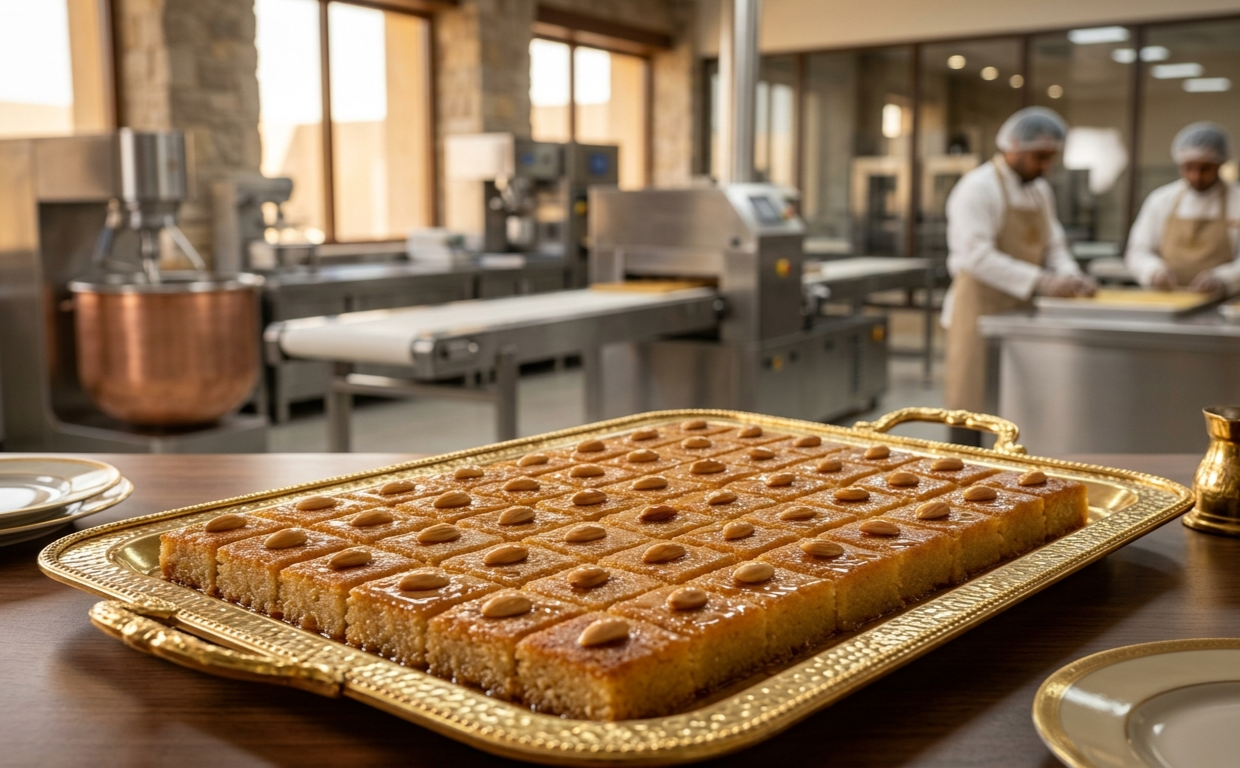
Hareesa production has become an increasingly important segment within the modern dessert manufacturing industry. Known in many regions as a soft semolina-based sweet soaked in syrup, Hareesa is widely appreciated for its rich flavor, moist texture, and comforting traditional character. In several international markets, this dessert is also recognized under the name Basbousa, a closely related semolina cake widely popular across the Middle East and North Africa. As demand for traditional semolina desserts continues to grow in both regional and global markets, food manufacturers are exploring efficient ways to scale Hareesa production while maintaining the authentic qualities that consumers expect.
Traditional hareesa preparation relies heavily on manual mixing, visual baking control, and small batch preparation. While this approach works well in bakeries and local sweet shops, industrial hareesa production requires a far more disciplined process. Manufacturers must manage ingredient consistency, baking conditions, syrup absorption, and product stabilization to ensure that every tray delivers the same taste, structure, and moisture balance.
Successful hareesa production therefore depends on translating a traditional dessert recipe into a carefully controlled manufacturing process that can deliver consistent quality at scale. The same industrial principles are often applied to similar desserts such as Basbousa, where maintaining texture and syrup distribution is equally critical.
Understanding the Industrial Hareesa Production Process
Industrial hareesa production involves a sequence of processing stages designed to convert semolina batter into a stable baked dessert that maintains its softness and syrup balance throughout storage and distribution.
Although recipes may vary slightly between brands or regions, most hareesa production systems follow several essential stages:
• raw ingredient preparation and batching
• semolina batter mixing and hydration
• tray filling and leveling
• controlled baking
• syrup preparation and dosing
• cooling and stabilization
• cutting, packaging, and distribution
Each stage in hareesa production contributes directly to the final product’s structure, flavor, and shelf stability. These processing principles are also widely applied in large-scale manufacturing of semolina desserts like Basbousa, where consistency and moisture balance are essential for consumer acceptance.
Raw Ingredient Selection and Formulation Balance
Ingredient quality plays a decisive role in the success of industrial hareesa production. The dessert is typically based on semolina, sugar, fats, dairy components, and aromatic flavorings. Even small variations in these ingredients can influence texture, sweetness perception, and syrup absorption.
Key formulation considerations include:
• semolina granulation and water absorption capacity
• sugar concentration and sweetness balance
• fat composition and distribution within the batter
• dairy ingredients such as yogurt or milk
• baking agents and moisture regulators
For consistent hareesa production, manufacturers often implement standardized ingredient specifications and controlled batching systems. This approach helps reduce variability between production cycles and ensures that each batch behaves predictably during mixing and baking.
Mixing and Batter Hydration
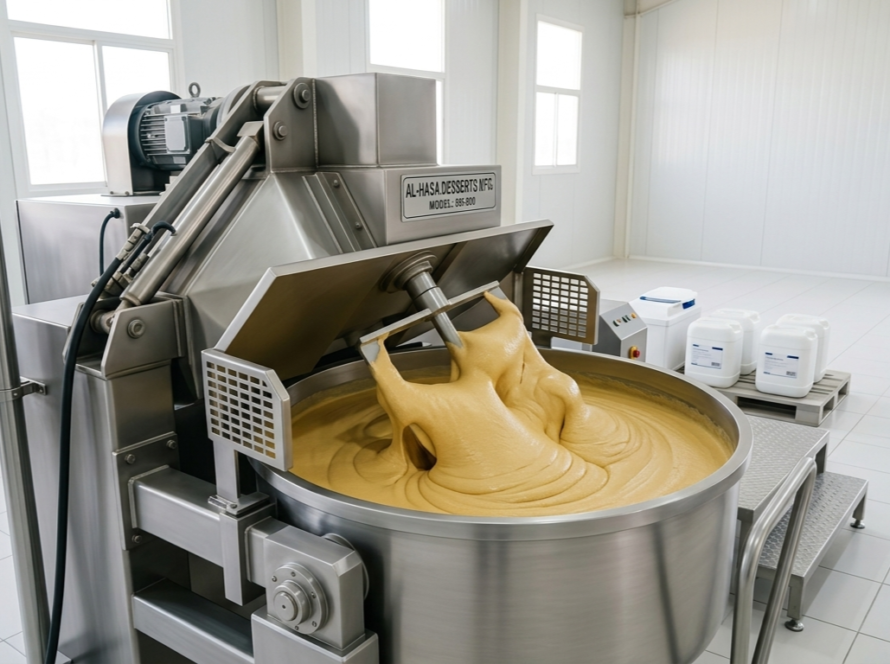
Mixing is one of the most critical technical stages in hareesa production. At this point, semolina particles must hydrate properly while the ingredients are evenly distributed throughout the batter.
During mixing, several parameters must be carefully monitored:
• mixing duration and speed
• hydration level of semolina particles
• batter viscosity and flow characteristics
If mixing is too short, the batter may remain uneven and produce irregular crumb structures after baking. On the other hand, excessive mixing can negatively affect batter structure and lead to dense or compact textures.
Controlled mixing allows the batter to spread smoothly across trays while supporting uniform baking and stable internal structure.
Tray Forming and Thickness Control
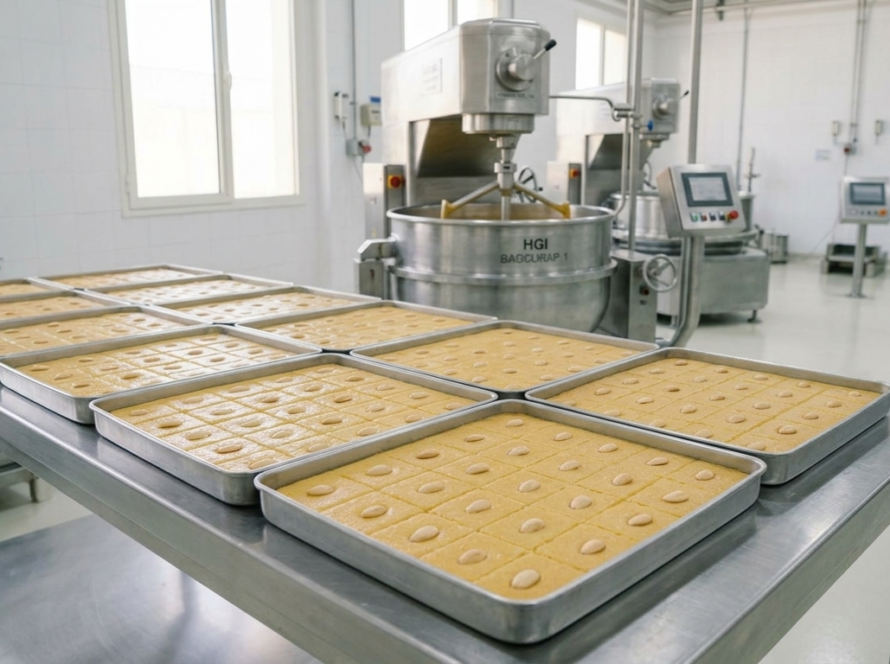
Once mixing is complete, the batter is transferred into baking trays. Uniform thickness is essential in industrial hareesa production because it directly influences baking consistency and syrup absorption.
Industrial systems typically include:
• automated tray dosing equipment
• leveling systems for consistent batter thickness
• optional topping placement such as almonds or pistachios
Uneven batter distribution may cause certain areas to bake faster than others. Maintaining consistent thickness ensures balanced heat penetration during baking and predictable syrup infusion later in the process.
Baking Control and Structural Development
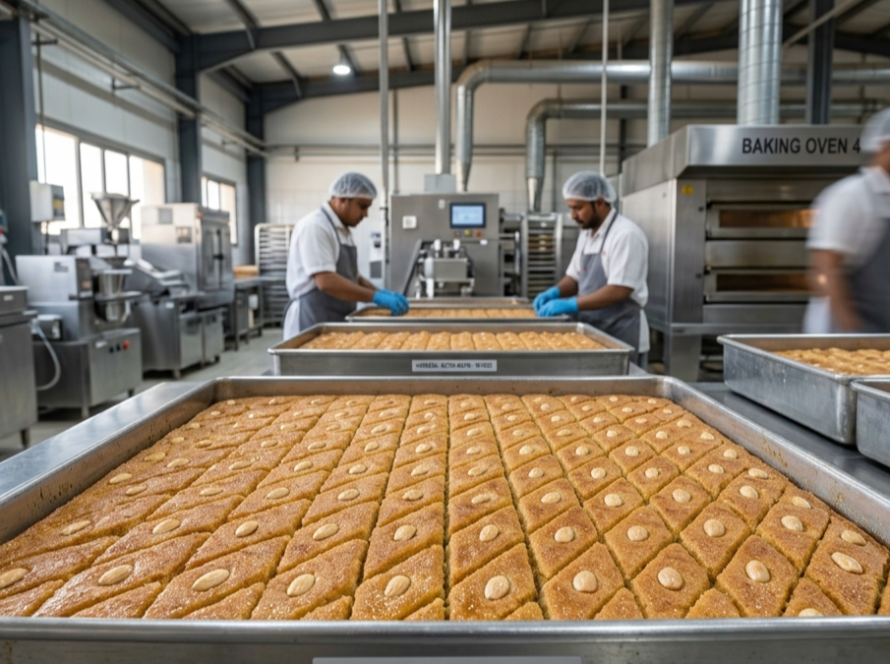
Baking is the stage where the batter transforms into the recognizable hareesa dessert structure. Heat triggers several important physical and chemical changes inside the product.
Key baking objectives include:
• moisture evaporation and crumb formation
• starch gelatinization within semolina
• development of a lightly golden surface color
Temperature stability and air circulation inside industrial ovens play an important role in achieving uniform results. If oven conditions fluctuate, the product may develop uneven coloration, overly dry edges, or an undercooked center.
Carefully controlled baking conditions are therefore essential for stable hareesa production.
Syrup Preparation and Absorption
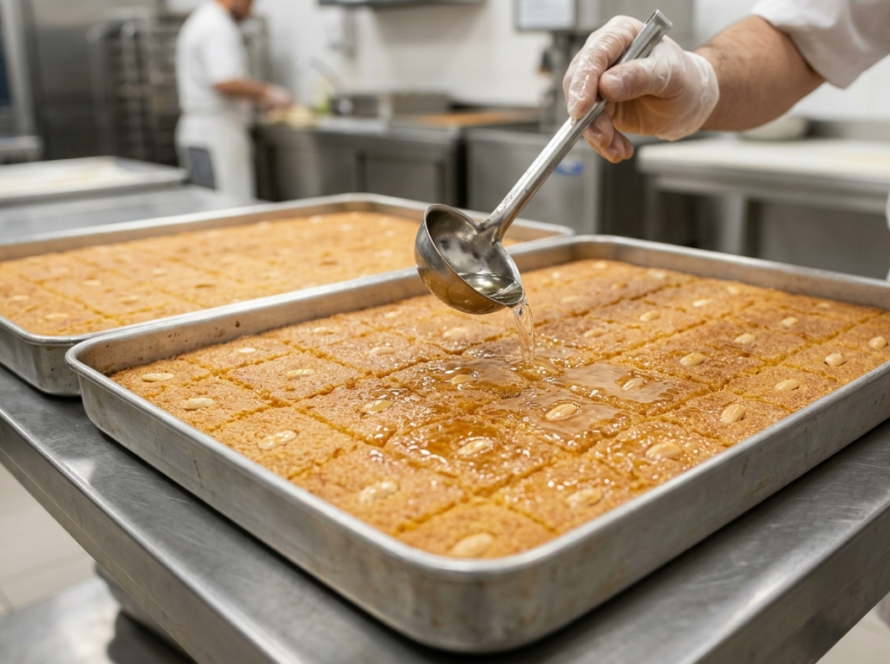
One of the defining characteristics of hareesa is its sweet syrup infusion. The syrup, typically prepared with sugar and water and sometimes flavored with citrus or floral notes, is poured over the dessert shortly after baking.
Proper syrup management is critical in hareesa production and involves several important variables:
• syrup concentration and viscosity
• syrup temperature during application
• timing of syrup dosing after baking
If syrup is added too early, the structure of the dessert may collapse under the added moisture. If added too late, the baked surface may resist absorption.
When syrup infusion is properly timed and controlled, the dessert absorbs moisture evenly while maintaining structural integrity.
Cooling and Product Stabilization
After syrup infusion, the product must cool gradually so that moisture distributes evenly throughout the dessert.
Cooling and stabilization stages in Hareesa production typically involve:
• controlled airflow and ambient cooling conditions
• sufficient resting time for syrup penetration
• structural stabilization before cutting
During this stage, the internal crumb structure settles and becomes easier to portion without damaging the product.
Stable cooling conditions also help prevent surface condensation and maintain the dessert’s final appearance.
Cutting, Portioning, and Packaging
Once the dessert has stabilized, the trays are cut into individual portions. Cutting systems must maintain clean edges while preserving the delicate crumb structure of the product.
Industrial hareesa production lines may include:
• automated cutting grids
• portion control systems
• hygienic transfer to packaging stations
Packaging is essential for protecting the dessert’s moisture balance and preventing contamination during storage and transportation.
Common packaging formats include:
• sealed trays for retail markets
• individual flow-wrapped portions
• rigid containers for food service distribution
Proper packaging helps maintain freshness and ensures that the dessert reaches consumers in optimal condition.
Maintaining Consistency in Industrial Hareesa Production
Scaling hareesa production from artisanal preparation to industrial manufacturing requires more than larger equipment. It requires systematic control over ingredients, processing conditions, and quality assurance procedures.
Manufacturers typically evaluate several operational factors:
• ingredient standardization and supply stability
• mixing performance and batter hydration consistency
• baking temperature uniformity
• syrup dosing accuracy
• hygienic production line design
• repeatable batch performance
When these parameters are carefully controlled, hareesa production can become a reliable and scalable dessert manufacturing process capable of meeting growing market demand for traditional semolina desserts such as Basbousa and similar regional specialties.
Conclusion
Hareesa production illustrates how traditional desserts can successfully transition into modern food manufacturing environments. By combining disciplined ingredient control, optimized baking systems, and carefully managed syrup infusion, producers can preserve the authentic taste and texture that define this beloved dessert.
With the right technical approach, industrial hareesa production can deliver both product consistency and efficient large-scale output while maintaining the traditional character that consumers value.
Start today with a comprehensive technical evaluation of your production line. Contact ProNano and transform your industrial production systems into disciplined, stable, and scalable manufacturing operations.
Read more about How to transform chocolate into a luxurious experience with liquid filling?