What Defines Non-Alcoholic Plant-Based Spirits?
At first glance, these products may resemble flavored beverages or herbal extracts. In practice, they behave differently once you move beyond formulation. They are designed to recreate the structure and sensory experience of traditional spirits, including flavor progression, aromatic lift, and finish. Removing alcohol changes how compounds dissolve, interact, and release over time.
A typical system includes:
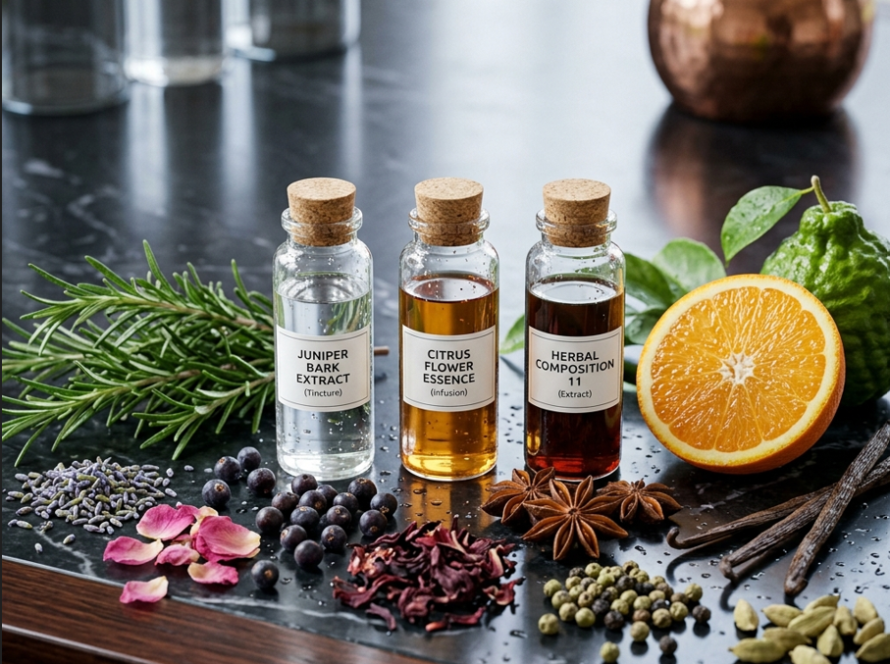
• Botanical extracts such as herbs, spices, and roots
• A structured water phase with a controlled mineral profile
• Distillates or hydrosols carrying volatile fractions
• In some cases, functional components that add another layer of complexity
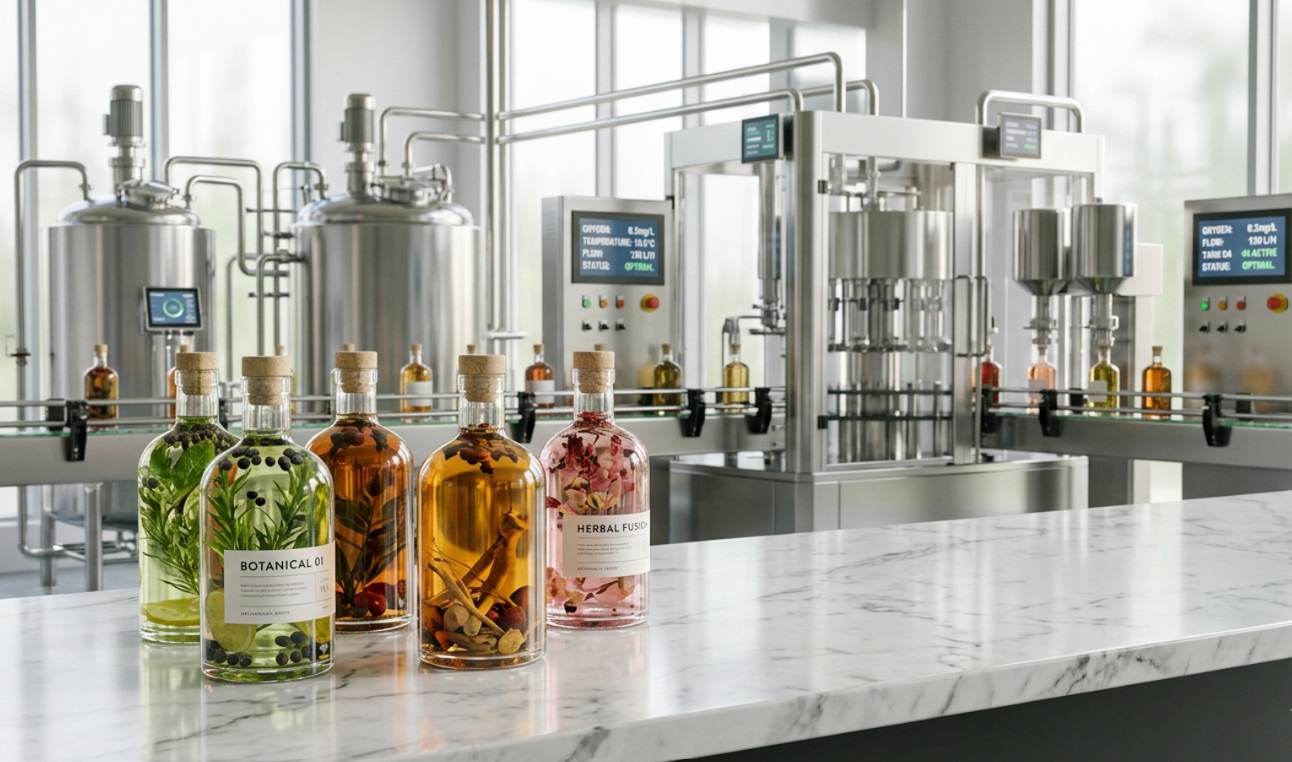
The key difference is not what goes in, but how these elements are processed, protected, and balanced across the entire production chain, ensuring industrial consistency in non-alcoholic beverage production.
How They Differ from Juices and Traditional Beverages
One of the most common issues in early development is treating these products like juice or flavored drinks. Juices rely on sugar, pulp, and acidity to create body and stability. Here, most of that support is missing, so the structure has to be built intentionally.
From an industrial standpoint:
• Flavor is layered, often requiring multiple extraction or blending stages
• Mouthfeel needs to be engineered to compensate for the absence of ethanol
• Low sweetness leaves very little room to mask imbalance
• Volatile compounds are more exposed during processing
In several cases we have seen, a batch performs well immediately after blending, but within a few weeks, the profile becomes noticeably flatter. The root cause is often not the recipe itself, but oxygen pickup during transfer or filling, a key consideration in plant-based spirits industrial production.
Why the Market Is Growing
The expansion of Non-Alcoholic Plant-Based Spirits is not only driven by health positioning. It reflects a change in how consumers approach drinking occasions. There is increasing demand for premium non-alcoholic beverages that offer structure and experience, even without alcohol. Consumers are looking for something deliberate, not just a substitute.
Key drivers include:
• A shift toward premium non-alcoholic options
• More social settings where alcohol is reduced or avoided
• Preference for plant-based and clean-label formulations
This positions these products between soft drinks and traditional spirits, creating market opportunities for manufacturers seeking high-value differentiation.
Product Categories and Industrial Relevance
Gin Alternatives
Currently the most defined segment. Profiles depend heavily on juniper, citrus, and spice extraction. Timing is critical; even short delays between extraction, blending, and filling can reduce top-note intensity.
Botanical Spirits
A broader, flexible category covering herbal, floral, and spice-driven profiles. Flexibility comes with variability. Without tight control over extraction and blending, two batches with the same formulation can differ in aroma or balance.
Functional Beverages
Some formulations incorporate adaptogens, vitamins, or other active ingredients. Stability extends beyond flavor. Interactions between functional compounds and botanicals can affect clarity, taste, and shelf life. In a few cases, precipitation appears only after distribution.
Industrial Production Considerations
Scaling Non-Alcoholic Plant-Based Spirits requires controlling a system where small deviations amplify effects on the final product.
Critical areas include:
• Selection of extraction method depending on target profile
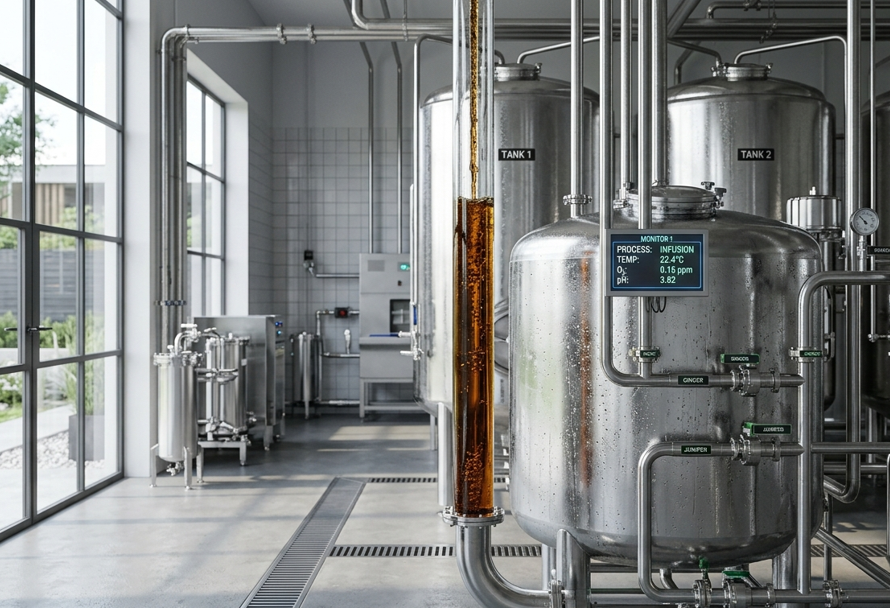
• Oxygen management across mixing, transfer, and filling
• Thermal exposure during processing steps
• Stability of emulsions or dispersions when oils are involved
• Packaging impact, especially light exposure and headspace oxygen
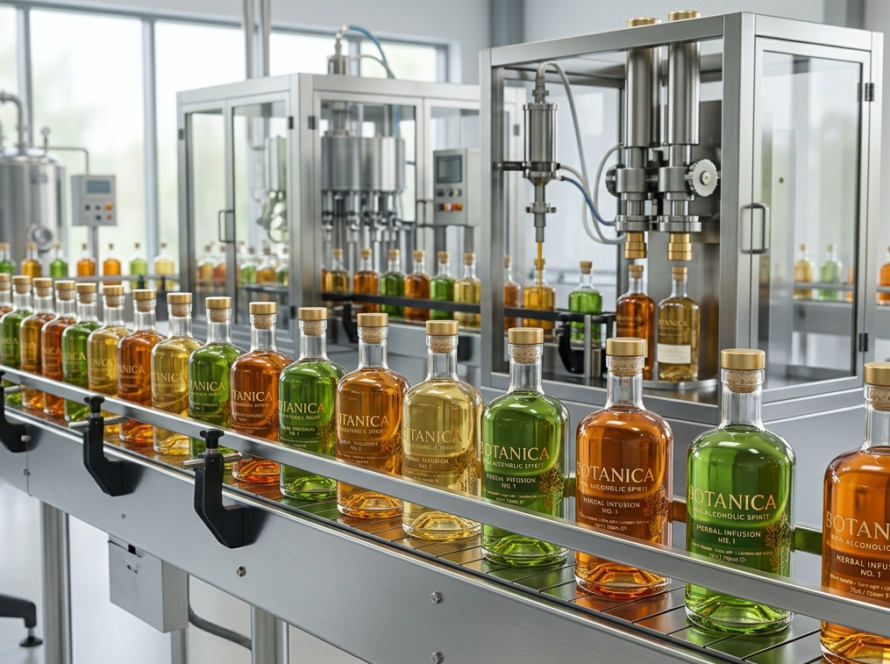
Even a slight increase in residence time before filling can initiate oxidation of delicate botanicals. The result is a gradual loss of brightness that is hard to detect early and impossible to recover later. At ProNano, we have seen cases where two runs using the same formula delivered different shelf-life performance due to oxygen control differences, highlighting process control as a key factor in industrial plant-based spirits.
Market Opportunity for Manufacturers
From a manufacturing perspective, this category offers strong potential, but only when technical execution matches product ambition. It allows:
• Premium positioning with higher value perception
• Differentiation through formulation and sensory design
• Flexibility in branding across multiple sub-categories
Inconsistencies in stability or flavor retention are quickly visible to the end consumer. The opportunity is real but requires strict industrial production discipline.
How to Enter the Market Strategically
For manufacturers, starting with flavor alone is rarely sufficient. A reliable entry approach defines:
• The intended sensory profile over time, not just at production
• The actual capabilities and limitations of the production line
• Shelf-life expectations under realistic distribution conditions
Formulation and process must be developed together. A practical path includes:
• Pilot-scale trials under conditions close to real production
• Oxidation and stability testing beyond initial sensory evaluation
• Packaging selection based on product sensitivity, not only availability
Products performing well in controlled development environments can behave differently once exposed to transport, storage, and time.
Conclusion
Non-Alcoholic Plant-Based Spirits represent a technically demanding but promising category. Success depends on understanding how processing decisions influence flavor stability, product behavior, and consumer perception across shelf life. For teams linking formulation with process control, results can be both stable and commercially competitive.
If you are exploring how to develop or scale such products with consistent quality, flavor, and stability, Contact ProNano.
Read more about Understanding and Maximising Drinks Shelf-Life.