




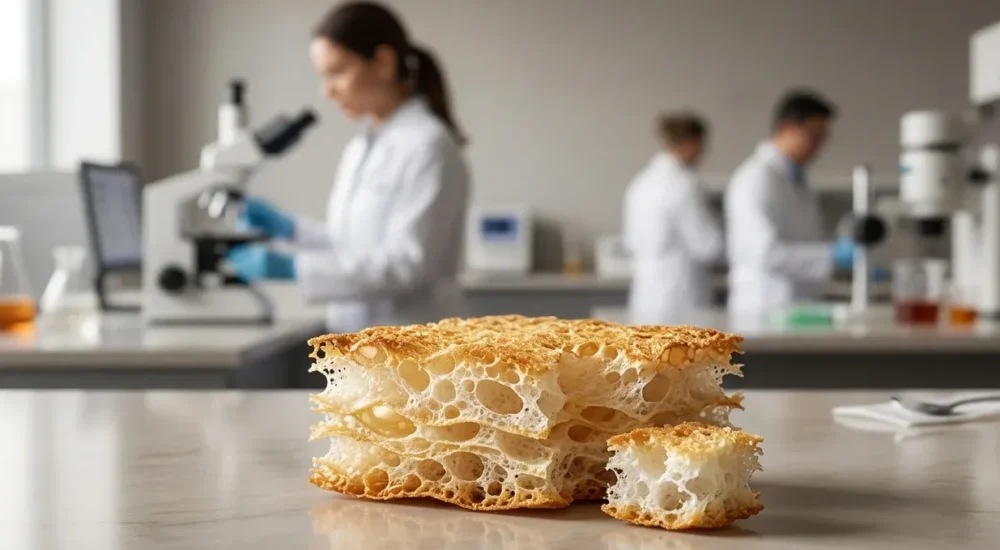
Saturated Edible Aerogel Foams
The food innovation sector is undergoing an unprecedented and radical transformation today. Specifically, experts and scientists are now focusing heavily on Structural Food Engineering, moving far beyond traditional ingredient tweaking or chemical composition adjustments. In this advanced context, saturated edible aerogel foams are emerging as a revolutionary technology that is actively reshaping the concept of satiety. This technique relies on designing the architecture of food itself, without needing to increase caloric intake or add heavy mass.
Consequently, this structural breakthrough alters the nature of the digestive response and mouthfeel for consumers. Moreover, it delivers a strategic and intelligent solution to the drawbacks of conventional products. This advantage appears clearly in functional foods, weight management, sports nutrition, and specialized medical nutrition, where structural efficiency has become the primary driver for commercial success in modern markets.
Why Is Structural Satiety Becoming Crucial in Modern Manufacturing?
Traditional food development systems usually rely on increasing nutritional density to achieve fullness. Specifically, manufacturers remove fats while increasing protein content or adding large amounts of fibers and hydrocolloid thickeners. However, these conventional approaches create clear sensory and industrial limitations over time.
Furthermore, excessive viscosity in standard formulations noticeably reduces consumer sensory acceptance. In addition, high-fiber systems cause complex digestive and processing challenges during production. As a result, saturated edible aerogel foams address these issues effectively. Because these systems control internal pore volume and structural collapse behavior rather than increasing heavy product mass.
Key Advantages of Transitioning Toward Structural Efficiency:
- Enhanced Consumer Sensory Acceptance: As a result, the product maintains its lightness and smoothness while delivering a full and rapid feeling of satiety.
- Streamlined Manufacturing Operations: In addition, producers completely avoid unwanted high viscosity on production and packaging lines.
- Direct Support for Digestive Comfort: Consequently, consumers achieve extended satiety without experiencing gastrointestinal strain or bloating.
- Controlled Nutrient Release Rate: Furthermore, micro-porosity enables precise inhibition of rapid nutrient absorption.
When Air Becomes a Functional Element in Food Architecture
Systems using saturated edible aerogel foams differ fundamentally from traditional puffed and air-injected snacks. Because conventional products utilize air merely to reduce apparent density and weight. Conversely, modern aerogel technologies make air distribution an active and precisely calculated functional element within the molecular matrix.
Furthermore, nano- and micro-porosity directly impact hydration dynamics and saliva interaction inside the mouth. Consequently, structural resistance changes during chewing, which extends the Oral Processing Time. As a result, the body sends early satiety signals to the brain well before digestion and nutrient absorption are completed in the stomach and intestines.
Scientific and Technical Mechanisms of Aerogel Foam Formation
Engineering these advanced foams relies on sophisticated physical and chemical techniques to build the porous structure:
- Hydrogel Formation: Specifically, the process begins by constructing a cohesive polymer network from edible polymers such as polysaccharides or proteins.
- Entrapped Liquid Replacement: Alternately, water is replaced with suitable aqueous or gaseous compounds that maintain structural stability without collapsing the network.
- Supercritical Drying: Consequently, liquid is removed while preserving micro-pores instead of shrinking the matrix, producing saturated edible aerogel foams with high surface area.
- Matrix Resistance Control: Furthermore, this approach allows precise prediction of the dissolution rate within gastric fluids.
Industrial Challenges in Producing Edible Aerogel Foams
Engineering saturated edible aerogel foams for food applications requires extremely strict control over manufacturing and processing conditions. Specifically, key technical and industrial challenges include:
- Balancing Rigidity and Collapse Behavior: Highly fragile structures disintegrate during transport, whereas overly rigid structures lose sensory appeal inside the mouth.
- Controlling Water Activity: Because minor shifts in ambient humidity alter porosity, texture, and shrinkage behavior over time.
- Precision of Drying Technologies: Furthermore, freeze-drying or spray-drying methods directly determine final pore geometry and surface area.
- Managing Production Costs: As a result, research pipelines focus on streamlining processes to suit large-scale industrial manufacturing.
Primary Industrial Applications for Aerogel Technology
1. Weight Management and Calorie-Controlled Products
Manufacturers apply this technology to expand volumetric food mass within the stomach. For instance, primary applications include:
- Meal replacement snacks.
- Functional foods tailored for low-calorie diets.
- In addition, dietary supplements for long-term satiety.
2. Specialized Sports and Medical Nutrition
The porous structure of aerogel foams optimizes gradual nutrient release. Consequently, athletes and patients benefit from a steady energy supply without experiencing gastric heaviness during physical activity.
3. Enhanced Stability and Bioactive Compound Delivery
Furthermore, saturated edible aerogel foams serve as excellent carriers for sensitive compounds such as vitamins, essential oils, and micronutrients, protecting them from oxidation and ensuring intestinal release.
The Future of Food Innovation – Satiety as a Structural Issue
The global food industry is rapidly shifting toward treating satiety as a mechanical and structural phenomenon rather than merely a chemical one. Consequently, manufacturers will transition from simply mixing ingredients to designing complete food architecture with structural intelligence, directly controlling how the body experiences food.
Conclusion
Ultimately, saturated edible aerogel foams represent a fundamental leap forward in modern food science. Because physical structure and internal porosity transform into physiological control tools that redefine product quality and deliver a powerful competitive advantage.
Contact the Pronano team today to discover how aerogel technologies and texture engineering can help you build next-generation functional foods on an industrial scale.