





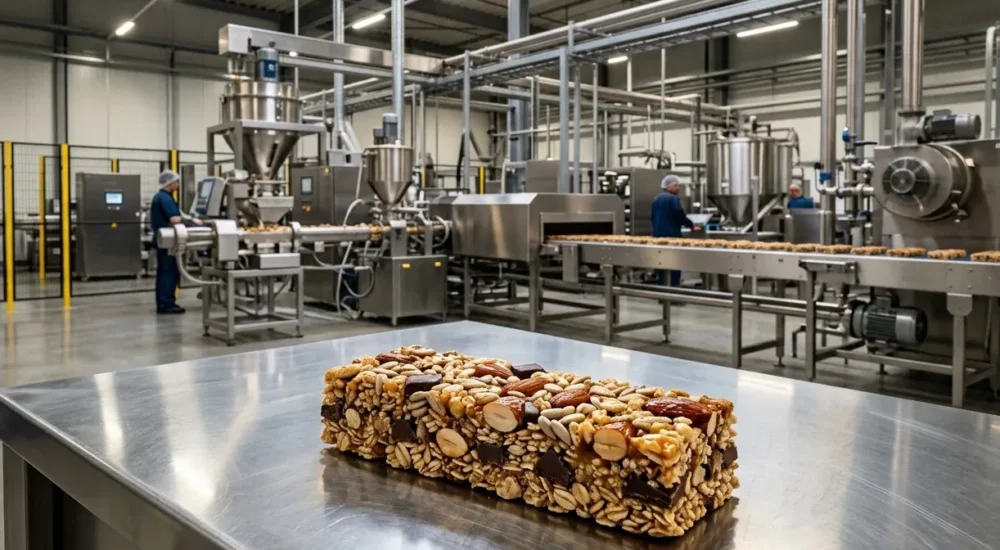
Osmotically Optimized Snacks
The traditional food industry usually operates under a simple product development premise. Specifically, manufacturers assume that a successful snack only needs to deliver sufficient calories, maintain shelf stability, and achieve consumer taste acceptance. However, real-world consumption conditions are far less controlled. Indeed, high heat, intense physical activity, and irregular hydration levels fundamentally change how a food formulation interacts inside the human body. In this advanced context, osmotically optimized snacks are emerging as a revolutionary technology that leverages osmolality control to maximize physiological energy availability efficiently.
Consequently, this breakthrough goes far beyond conventional caloric evaluation. Moreover, it delivers a strategic solution that links structural food efficiency directly to the biological response of the stomach and intestines. This benefit appears clearly in sports nutrition, extreme condition fueling, and specialized medical nutrition, where osmolality engineering serves as the primary driver for rapid nutrient absorption and hydration without digestive strain.
Why Must Snack Development Move Beyond Fragmented Formulations?
Most food companies traditionally design snack systems in isolated layers. Specifically, manufacturers add carbohydrates for energy, proteins for structure, fats for texture, and electrolytes almost as an afterthought. However, while this approach is technically valid, it fails to reflect what actually happens inside the body after consumption.
Furthermore, the moment a solid snack enters the digestive tract, it transforms into part of a dynamic liquid environment. In addition, the matrix becomes subject to osmotic pressure and concentration gradients across cell membranes. As a result, osmotically optimized snacks address this flaw effectively. Because they engineer ingredients as an integrated system that precisely regulates fluid movement and nutrient absorption rates.
Key Advantages of Osmolality Control in Food Products:
- Accelerated Gastric Emptying Rate: As a result, an osmotically optimized formulation prevents stomach heaviness or nausea during strenuous effort.
- Enhanced Hydration Efficiency: In addition, controlled osmolality ensures that fluids flow seamlessly into the bloodstream.
- Consistent Bioavailability of Energy: Consequently, the body receives a steady, sustained supply of calories without energy crashes.
- Reduced Gastrointestinal Distress: Furthermore, optimal osmotic balance minimizes reverse water influx into the intestinal lumen.
When a Solid Snack Transforms into a Dynamic System
The concept of osmotically optimized snacks extends far beyond adding a new functional claim to the packaging label. Because osmotic engineering fundamentally changes how developers conceptualize products from the very first design stage. Specifically, the food transitions from a static mass into a responsive control system that adapts upon interaction with physiological fluids.
Furthermore, scientists select carbohydrates based on molecular weight and direct osmotic contribution rather than sweetness alone. Consequently, electrolytes play a pivotal role in cellular fluid distribution. As a result, hydrocolloid networks maintain internal diffusion behavior and govern structural dissolution at a precisely calculated pace over time.
Scientific and Technical Mechanisms of Osmotic Engineering
Engineering osmotically optimized snacks relies on sophisticated mechanisms to govern osmotic pressure:
- Carbohydrate Molecular Tuning: Specifically, developers blend maltodextrins with monosaccharides to achieve high caloric density alongside low osmolality.
- Precise Electrolyte Balancing: Alternately, sodium and potassium ratios are fine-tuned to enhance dual-route intestinal transporter absorption.
- Hydrocolloid Diffusion Control: Consequently, hydrocolloid matrices regulate solute release within the aqueous gastric environment.
- Preserving Osmotic Stability: Furthermore, this technology prevents ingredient crystallization or moisture migration that could alter performance during storage.
Industrial and Sensory Challenges in Managing Osmolality
Managing osmolality across commercial production lines requires rigorous control over every manufacturing stage. Specifically, key technical challenges include:
- Impact of Thermal Processing and Extrusion: High heat and shear forces alter solute molecular structures, inadvertently increasing osmolality.
- Balancing Functionality with Sensory Acceptance: Because elevated electrolyte concentrations can introduce off-putting salty or metallic notes.
- Sensitivity to Water Activity: Furthermore, ambient moisture absorption triggers premature reactions that degrade functional performance over time.
- Advanced Quality Control Testing: As a result, production facilities require osmometry tools that go far beyond standard quality checks.
Primary Industrial Applications for Osmotically Optimized Snacks
1. Sports Nutrition and Endurance Fueling
Athletes utilize these products to secure immediate energy and rapid fluid recovery. For instance, key applications include:
- Energy gels engineered for marathon and triathlon performance.
- Energy bars designed for prolonged endurance activities.
- In addition, recovery formulations tailored for rapid post-exercise rehydration.
2. Extreme Work Environments and Harsh Climates
Osmotic engineering supports industrial workers and military personnel operating in high temperatures. Consequently, the body maintains physical and cognitive performance without requiring excessive water intake.
3. Medical Nutrition and Emergency Feeding Systems
Furthermore, osmotically optimized snacks support patients and elderly individuals facing malabsorption, ensuring gentle nutrient delivery without intestinal discomfort.
The Future of Food Innovation – Controlling Biological Interaction
The global food industry is rapidly shifting toward defining product efficiency through real physiological response. Consequently, food manufacturers will transition from selecting ingredients based on superficial nutritional facts to engineering complete biological interactions, ensuring maximum nutrient availability for the body.
Conclusion
Ultimately, osmotically optimized snacks represent a fundamental transformation in how we approach energy delivery. Because osmolality evolves from a simple chemical property into a powerful engineering tool that dictates absorption speed and rehydration efficiency.
Contact the Pronano team today to discover how osmolality-based formulation strategies can help you build next-generation functional snacks on an industrial scale.